
GNSS Receivers & Accessories
A smaller footprint. The same discipline against multipath.
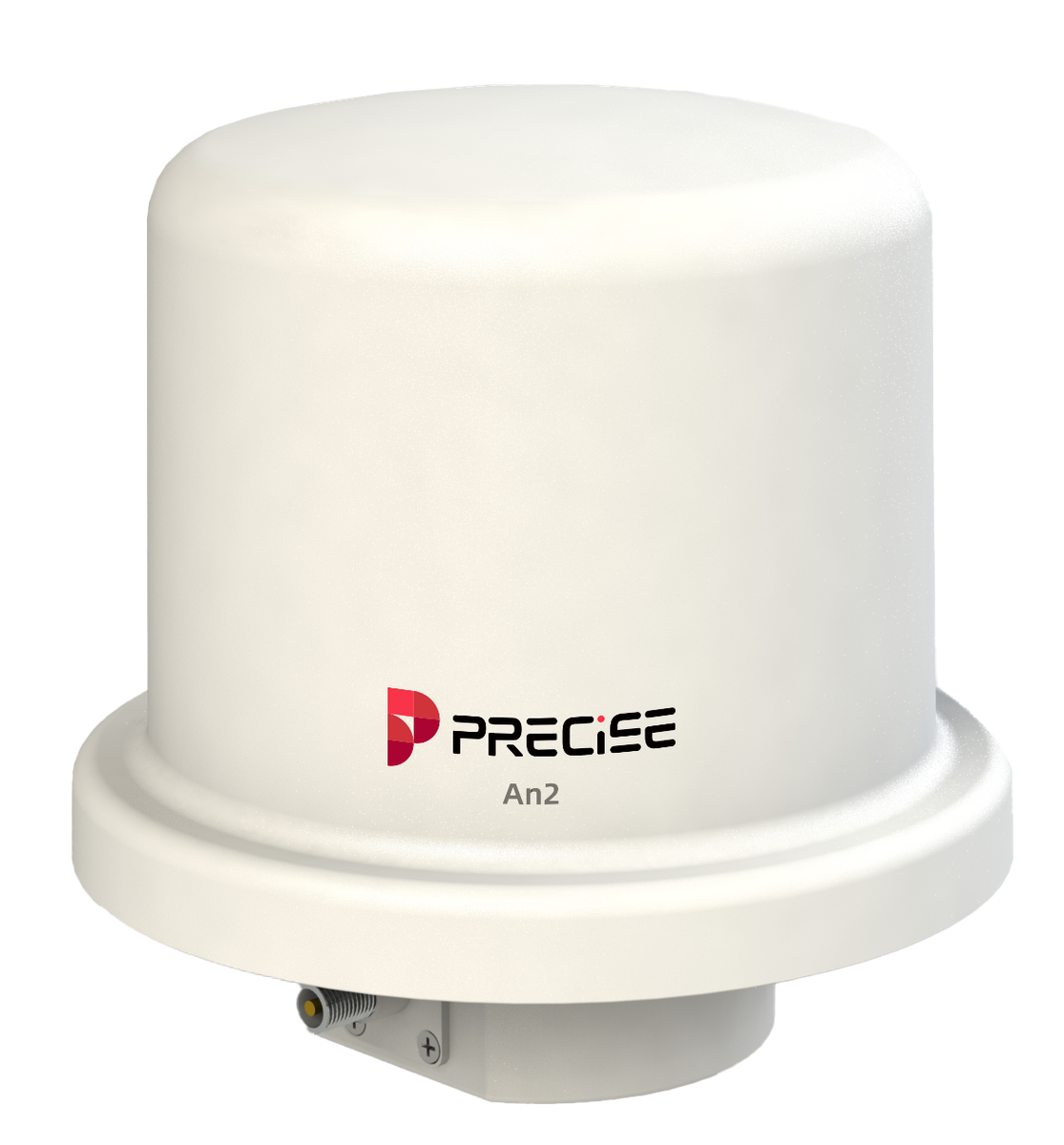
PRECISE AN2: Anti-Multipath Geodetic GNSS Antenna. Phase center error < 2 mm | GPS L1/L2, GLONASS L1/L2, BDS B1/B2/B3, Galileo E5 | IP67 | Φ180 × 180 mm, < 2.5 kg
PRECISE AN2 is a compact, anti-multipath GNSS antenna for reference stations and deformation monitoring, built for sites where reflected signals and mounting space both matter. It's the compact alternative to the full-size AN4 antenna, easier to mount on space- or weight-limited structures.
Challenge
On reference stations, monitoring points, and any fixed GNSS installation, the antenna sees the same sky every day, including the same reflections off nearby structures, ground, and metal. Multipath, phase-center drift, and out-of-band interference don't show up as a single dramatic failure; they show up as noise and inconsistency that accumulate across weeks and months of continuous observation, which is exactly what deformation monitoring and reference stations depend on getting right.
Solution
AN2 uses a multi-feedpoint, fully symmetrical antenna structure combined with a high cross-polarization ratio to suppress reflected signals and keep the electrical phase center aligned with the geometric center. A pre-filter low-noise amplifier stage adds further protection against out-of-band interference near communication towers and other RF sources.
Value
A more stable, more repeatable signal input for every calculation downstream, exactly what reference stations and long-term monitoring projects depend on.
Key Benefits
Why AN2
Phase center error under 2 mm
Phase center error under 2 mm
Cuts a systematic error that otherwise varies with satellite direction and frequency, important for deformation trend analysis and long-baseline work.
<0mm
Phase Center Error
An antenna-level spec: the symmetrical structure aligns the electrical and geometric centers; final system accuracy still depends on the full GNSS chain.
Antenna Geometry Multipath Suppression
Multipath suppression through antenna geometry, not marketing claims
More stable observations in the ground reflections, nearby structures, and low-elevation distortion that reference stations actually face.
≥0dB
Cross-Polarization Ratio
±0°
Suppression Angle Coverage
A ≥25 dB cross-polarization ratio (at ±60°) attenuates reflected signals before the low-noise amplifier.
Multi-constellation, multi-frequency coverage
Multi-constellation, multi-frequency coverage
Feeds your receiver the satellite geometry and frequency diversity RTK and multi-frequency processing need, rather than limiting it at the antenna.
Covers GPS L1/L2, GLONASS L1/L2, BDS B1/B2/B3, and Galileo E5 (1557–1612 MHz and 1164–1278 MHz).
Low-Maintenance Field Durability
Built to be installed once and forgotten
Lowers long-term maintenance for reference stations and monitoring points expected to run unattended for years.
IP0
Ingress Protection Rating
-40°C to +85°C
Operating Temperature Range
IP67 sealing, built-in lightning protection, a 3.3–12 V wide voltage input, and -40°C to +85°C operation (-55°C to +85°C storage).

Applications
Where It's Used
Customers
What Our Customers Are Saying
Mateo Fernández
Peru
“We monitor micro-deformation on a dam site, and the AN2's phase center stability under 2 mm has kept our baseline calculations consistent month after month. That's exactly what a monitoring project needs.”
Dmitri Volkov
Kazakhstan
“Our reference station sits near a row of steel silos, and reflections used to add noticeable noise. Since switching to the AN2, the antenna's geometry suppresses those reflected signals and our observations are far more stable.”
Nguyen Van Minh
Vietnam
“The AN2 feeds our RTK receiver full GPS, GLONASS, BDS, and Galileo tracking, so we get the satellite geometry we need instead of being limited by the antenna. It's a small unit that doesn't compromise on coverage.”
Amara Kimathi
Kenya
“Our CORS point runs unattended in a hot, dusty region, and the AN2's IP67 housing has held up without a single maintenance visit since installation. It was built to be installed once and forgotten, and that's been true for us.”
Technical Highlights
Engineered Detail
Multi-feedpoint, fully symmetrical antenna structure for phase-center stability
High cross-polarization ratio (≥25 dB at ±60°) for multipath suppression
Pre-filter low-noise amplifier architecture (filter before amplify)
Built-in lightning protection circuit
Compact form factor (Φ180 × 180 mm, < 2.5 kg) relative to full 3D choke-ring designs
IP67-rated, wide-temperature (-40°C to +85°C) outdoor housing
Technical Specifications
Full Spec Sheet
Electrical Specifications
Structural Characteristics
Environmental Requirements
How It Works
From Setup to Result
Suppress reflected signals and keep the phase center stable
The antenna's symmetrical, multi-feedpoint structure and high cross-polarization ratio suppress reflected (multipath) signals and keep the phase center stable across GPS, GLONASS, BDS, and Galileo signals.
Filter before amplifying
The low-noise amplifier filters out-of-band interference before amplification, rather than after, reducing the chance that a nearby strong signal source saturates the amplifier and degrades the whole GNSS chain.
Pass the clean signal to your receiver
The filtered, amplified signal passes through a TNC-K connector to your GNSS receiver, which performs the actual positioning calculation.
Run continuously, unattended
The IP67-sealed, lightning-protected housing and 3.3–12 V wide-voltage design let the antenna operate continuously outdoors, in temperatures from -40°C to +85°C, without routine intervention.
FAQ
Common Questions
AN2 uses a multi-feedpoint, fully symmetrical structure combined with a cross-polarization ratio of ≥25 dB at ±60°, specifically designed to attenuate reflected signals from ground, structures, and metal surfaces before they distort the observation. This is a structural and RF design characteristic, not a firmware feature.
No. The <2 mm figure is an antenna-level phase-center specification. Final system accuracy depends on the complete GNSS chain (receiver, algorithm, baseline length, and site conditions), not the antenna alone.
GPS L1/L2, GLONASS L1/L2, BDS B1/B2/B3, and Galileo E5, covering the 1557–1612 MHz and 1164–1278 MHz ranges. Full system-level capability also depends on the connected receiver supporting the same constellations and frequencies.
Yes. It carries an IP67 rating, a built-in lightning protection circuit, and an operating temperature range of -40°C to +85°C (storage: -55°C to +85°C). Note that device-level lightning protection does not replace proper site grounding, surge protection, and lightning-rod design for the installation as a whole.
AN4 is a full 3D choke-ring antenna built for the highest level of multipath rejection on high-grade reference stations and extreme-environment sites. AN2 is more compact (Φ180 × 180 mm, < 2.5 kg vs. AN4's Φ379 × 312 mm, 9.3 kg bare) and easier to deploy where space, weight, or mounting conditions are constrained, while still holding phase-center error under 2 mm. Choose based on site constraints and multipath severity, not on treating one as a "better" version of the other.
3.3–12 V DC, with current draw under 65 mA, supplied through the TNC-K connector via the connected receiver or a compatible power source.
Get in Touch
Talk to PRECISE About AN2
Tell us about your project and we'll route it to the right PRECISE team.
- Sales: sales@precise-geo.com
- Support: support@precise-geo.com
Give Your Reference Station a Cleaner Signal to Start With.
Talk to our team about matching AN2 to your site conditions and receiver setup.