
GNSS Receivers & Accessories
Built to watch a structure, every hour, for years.
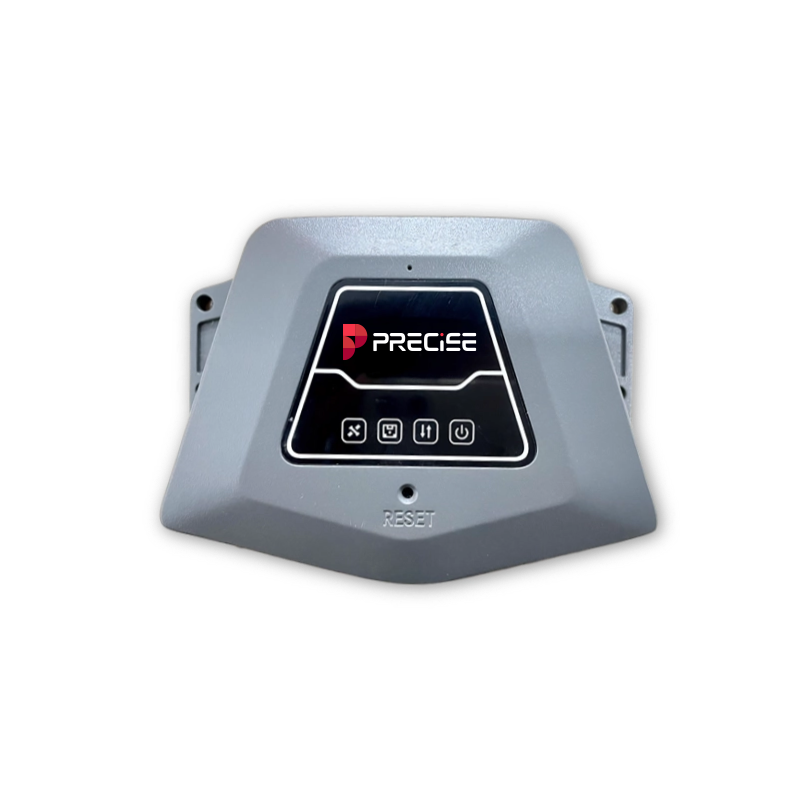
PRECISE C is a split-design GNSS receiver for permanent installation on bridges, dams, and precision structures, tracking every major constellation continuously and streaming high-frequency position data over Gigabit Ethernet into your monitoring and analysis system.
A compact, low-power GNSS monitoring receiver built to run permanently on a bridge, dam, or precision structure, feeding continuous position data into your structural monitoring system rather than serving as a survey crew's daily rover.
Challenge
Structural monitoring engineers need something fundamentally different from a survey crew's RTK rover: a receiver that stays powered on and installed at a fixed point for months or years, that can be mounted where a technician can service it separately from the antenna sitting on the structure itself, that fits into a low-power budget when a monitoring network has dozens of points, and that outputs data fast enough and continuously enough to feed a real analysis pipeline, without flooding it with more data than the network and servers can handle.
Solution
PRECISE C separates the antenna from the receiver, so each can be positioned where it works best: the antenna at the optimal observation point, the receiver wherever power and maintenance access are easier. It tracks every major GNSS constellation continuously and streams data at up to 50 Hz over Gigabit Ethernet, in a compact, low-power unit built for multi-point installation.
Value
A dependable, continuous stream of raw position data: the foundation your monitoring software needs to detect displacement and deformation trends over time.
Key Benefits
Why C
Split Antenna-Receiver Design
Split design built for permanent installation
The antenna goes exactly where the observation point requires (a bridge pier, a dam crest, a structure surface), while the receiver can sit somewhere easier to power, network, and service.
The antenna and receiver connect by cable while remaining physically separate, rather than combined into a single unit. Monitoring installations are permanent and often hard to access, so keeping the receiver separate reduces how often technicians need to work at the point itself.
Full-Constellation Multi-Frequency Tracking
Continuous tracking across every major constellation
Tracking more signals across more systems reduces data gaps at monitoring points with partial sky obstruction or nearby-structure multipath, protecting the continuous record deformation analysis depends on.
Tracks GPS, GLONASS, BeiDou (including new BeiDou-3 signals), Galileo, QZSS, and SBAS.
20 Hz Standard Output Rate
High-frequency output standard, when the monitoring task calls for it
Long-term drift can be tracked with standard-rate data, but dynamic events (vehicle loading, vibration under wind or traffic) need denser time resolution. C's standard rate covers most long-term monitoring, with a path to higher rates for dynamic-response projects.
0Hz
Standard Output Rate
0Hz
Optional High-Frequency Output
20 Hz output is standard, with up to 50 Hz available under authorization. A higher output rate means more frequent samples; per-sample precision still depends on the antenna, reference station, and processing method.
Compact Low-Power Gigabit Design
Low power, compact footprint, Gigabit network: built to scale
Monitoring networks often mean dozens of points, not one. A compact, power-efficient, Gigabit-networked receiver makes that many points practical to deploy and maintain without straining power or data infrastructure.

Applications
Where It's Used
Customers
What Our Customers Are Saying
Diego Fernández
Chile
“Our dam site has almost no shelter for electronics, so being able to mount the receiver away from the antenna, somewhere we can actually service it, made the whole installation practical.”
Elena Ivanova
Russia
“Our bridge monitoring points sit close to the steel structure with a lot of multipath. Tracking every constellation keeps the data gaps from breaking our deformation trend lines.”
Somchai Attaporn
Thailand
“For long-term drift the standard rate is enough, but when we needed to capture vibration during heavy truck loading, we authorized the 50 Hz output and finally saw the detail we needed.”
Yusuf Ibrahim
Egypt
“We run more than thirty monitoring points across our reservoir network. A receiver this compact and low-power is the only reason that many points was ever affordable to deploy.”

Resources
Downloads & References
Technical Highlights
Engineered Detail
Full-Constellation, BeiDou-3 Signal Tracking C tracks all major GNSS constellations, including new BeiDou-3 signals, giving monitoring installations broader signal availability in locations where partial sky obstruction or multipath from the structure itself would otherwise create data gaps.
High-Frequency Monitoring Output 20 Hz output is standard, with an authorized upgrade path to 50 Hz for projects that need to capture fast dynamic events, such as bridge vibration under load, in addition to long-term structural drift.
Distributed Front-End Resolution C supports distributed front-end processing, which reduces the computational burden on a central monitoring server and helps larger networks scale to more monitoring points without a proportional increase in server infrastructure.

Technical Specifications
Full Spec Sheet
GNSS
Positioning Accuracy & Timing
System & Communication
Physical & Environmental
How It Works
From Setup to Result
Install the antenna
(typically PRECISE's small 3D choke-ring antenna) at the structural observation point.
Install the receiver
in a location suited for power and network access, connected to the antenna by cable.
The receiver continuously tracks
GPS, GLONASS, BeiDou, Galileo, QZSS, and SBAS signals, generating raw observation data at 20 Hz (or up to 50 Hz with authorization).
Data streams over Gigabit Ethernet
to your monitoring server or software platform.
Your monitoring system compares the data against a stable reference station
to compute position changes over time, feeding trend analysis and, where configured, threshold-based alerting.
FAQ
Common Questions
No. PRECISE C is a fixed-installation GNSS monitoring receiver, designed to be permanently mounted on a structure and left running continuously, rather than carried on a survey pole for daily fieldwork. Its split antenna/receiver design, low power consumption, and 24/7 duty cycle are built specifically for structural monitoring, not general RTK survey.
No. C is the GNSS data acquisition component: it continuously outputs raw position observation data. Turning that data into displacement analysis, deformation trends, and any threshold-based alerts requires monitoring software, a properly maintained reference station, and an analysis model, none of which are built into the receiver itself.
No. Output frequency and positioning precision are separate characteristics. A higher data rate gives you more frequent position samples per second, useful for capturing fast dynamic events like bridge vibration, but the precision of each sample still depends on the antenna, reference station setup, baseline length, and processing method used in your monitoring system.
C connects via Gigabit Ethernet (RJ45, 10/100/1000 Mbps) for data transmission and takes 8–36V DC input with reverse-connection and surge protection. Like any permanently installed monitoring device, its long-term reliability depends on stable power and network connectivity being maintained at the installation site.
C is typically paired with a small 3D choke-ring antenna. PRECISE offers the AN2 (miniaturized anti-multipath antenna) and AN4 (4-system full-band 3D choke-ring antenna) for this purpose. Antenna choice affects multipath rejection and overall data quality, so it should be selected to match your monitoring site's environment.
C is designed for bridges, dams and reservoirs, and other precision structures that require continuous, long-term position monitoring, typically deployed as multiple monitoring points alongside a stable reference station, feeding a monitoring analysis system operated by the structure's engineering or asset management team.
Get in Touch
Talk to PRECISE About C
Tell us about your project and we'll route it to the right PRECISE team.
- Sales: sales@precise-geo.com
- Support: support@precise-geo.com
Start Monitoring With Confidence.
Talk to our team about matching C to your structural monitoring installation.